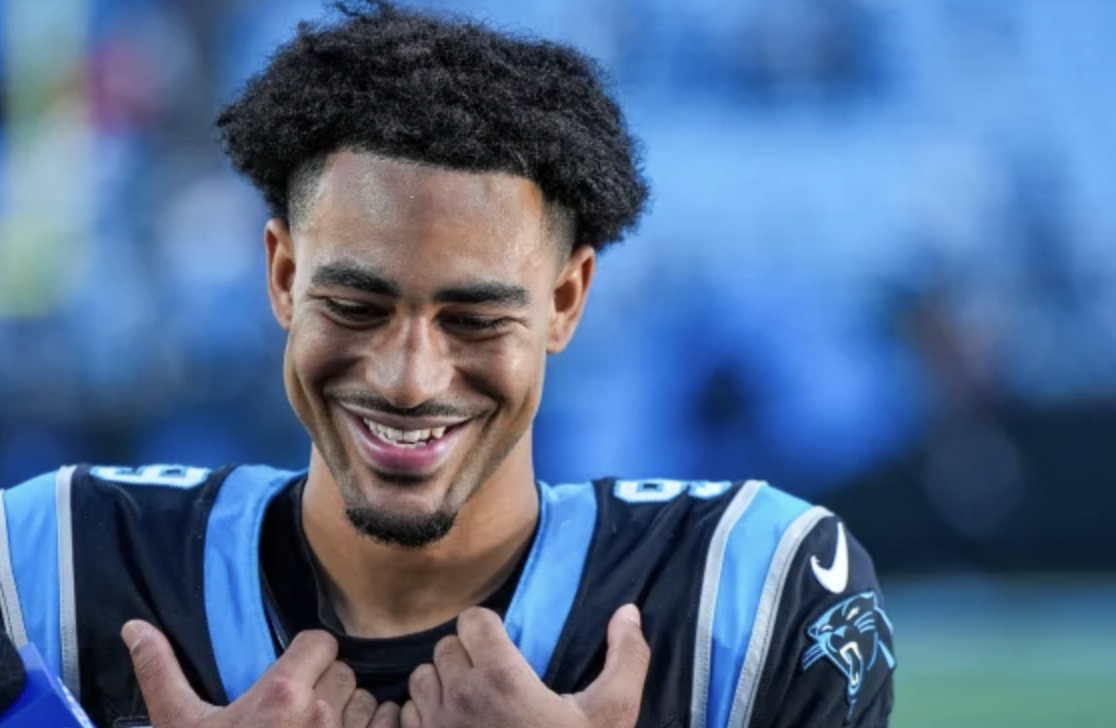
Bryce Young: Boom or bust?
There was a lot of talk this season about whether Bryce Young was a good fit. This blog digs in on Young’s pros and cons.
Bryce Young’s performance in the second half of the season finally gave the organization a reason to exhale. Twenty months after trading a massive haul for the undersized quarterback, the team finally saw a glimpse of the player they envisioned in 2023. Like Kyler Murray and Russell Wilson, Young will always have to contend with his lack of size. However, there’s a noticeable difference—Young doesn’t appear as stout as the other two quarterbacks of similar stature. It’s worth noting that 25 years ago, players like Young might not have been given the same opportunities. The traditional NFL quarterback standard was 6’2”, which eventually dropped to 6’0”(with Drew Brees) and now includes several examples at
5’10’’.
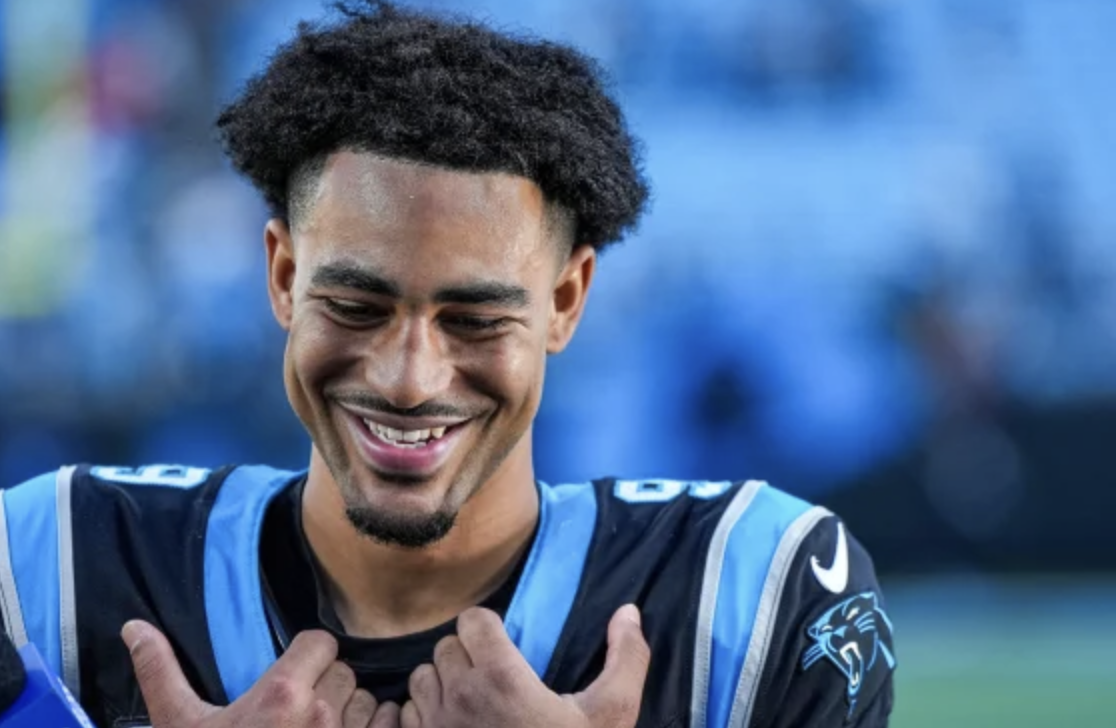
Bryce Young.
Historically, teams have been less concerned with a quarterback’s height than with other challenges shorter players face—specifically, hand size. Since most physical attributes are proportional, shorter quarterbacks often have smaller hands, making it harder to grip frozen footballs in December and January. The same is said with offense tackles. Arm length is a natural attribute sought for playing on the outside and in this case, taller people tend to have longer arms. The reality is that quarterbacks have always been shorter than their offensive linemen. For instance, Jonathan Ogden (6’9”) and Orlando Pace (6’8”) towered over quarterbacks like Trent Dilfer and Kurt Warner, who were both listed around 6’1” to 6’2”. Similarly, Bryce Young isn’t seeing over his linemen, like Ikem Ekwonu or Taylor Moton—he’s throwing through passing lanes in the pocket or rolling outside.
Dan Morgan’s key moves last year have proven critical to Bryce’s development. At the time, signing Robert Hunt and Damien Lewis seemed like overpayments—perhaps a result of the “bad team tax” or panic buying. In hindsight, however, those investments look like brilliant decisions. Combined with Taylor Moton’s consistent performance and Ikem Ekwonu’s improvement, they created a cleaner pocket for Young, preventing him from being forced to “throw from a well.”
Still, there’s work to be done. In my opinion, the team missed an opportunity in last year’s draft by failing to address the center position. There were excellent options available in the second round. While Jonathan Brooks has potential, the team could have drafted the next Ryan Kalil. Players like Jackson Powers-Johnson or Zach Frazier could have solidified the position for a decade, stepping into an ideal situation between two veteran guards.
A similar scenario played out in 2007 when the Panthers signed Justin Hartwig in free agency. Hartwig was a solid addition, along with other key signings like Ma’ake Kemoeatu and Ken Lucas. However, when the draft arrived, the Panthers made the smart decision to select Ryan Kalil, who went on to anchor the offensive line for 12 years. In contrast, the 2024 Panthers selected a running back—a devalued position—coming off an ACL injury. That choice will likely cost them two of the four years of his rookie contract.
In hindsight, the organization, and specifically the owner, overestimated Young’s ability to carry an offense. It was a mistake to label Bryce as a “point guard” who could distribute the ball effectively with lesser talent surrounding him. They gave up a lot to acquire Bryce, expecting him to immediately resemble the player he was at Alabama, without realizing he didn’t have the same level of talent around him in the NFL, nor did he have the raw physical ability or size of Cam Newton.
This brings me to a larger point about evaluating quarterbacks. Player evaluation is one of the most challenging aspects of the game. In 1998, there was significant debate over the top pick in the draft. While the Colts ultimately selected Peyton Manning, some questioned whether Ryan Leaf was the better prospect. Similarly, the 2011 draft had its own quarterback drama. Although many in Charlotte’s media assumed Cam Newton was the pick, some national mock drafts projected Blaine Gabbert going No. 1 overall.
The 2023 draft came down to Bryce Young and C.J. Stroud, with reports of a split between some combination of ownership, front office and the coaching staff. Both quarterbacks had the advantage of playing with superior talent in college. Alabama and Ohio State have consistently produced NFL-caliber receivers, giving Young and Stroud an edge that made it harder for scouts to evaluate how they’d perform in the NFL, where the playing field is more level.
Contrast that with quarterbacks like Patrick Mahomes, Josh Allen, Lamar Jackson, Jared Goff, or Brock Purdy—all of whom played at programs that weren’t national powerhouses but elevated the talent around them. This raises an important question: Should NFL teams focus more on quarterbacks who have demonstrated the ability to elevate average collegiate teams? Neither Young nor Stroud faced that challenge in college, and some might argue their supporting casts made them look better than they truly were.
As a longtime N.C. State fan, I’ve seen quarterbacks like Philip Rivers, Russell Wilson, Jacoby Brissett, Ryan Finley, and current Ravens backup Devin Leary succeed at varying levels in the NFL. N.C. State is far from a national power, but one thing all those quarterbacks had in common was their ability to elevate the play of those around them. Perhaps NFL teams should place more value on quarterbacks who can lead average college teams to 8 or 9 wins in college, rather than quarterbacks playing with NFL players in college.
Panthers’ Problems: Progress, pitfalls and the path forward
It’s the end of the season. How did we get here? Where will we go? Steven Webb digs in.
The Carolina Panthers faced numerous issues this season, but by the end of the year, the most glaring problem was their league-worst defense. While the scheme may have played a role in their inability to stop opposing offenses, the personnel certainly didn’t help.
The traditional 3-4 defense has historically relied on a base of larger, more physical players in the front seven. Think of past Steelers teams or the Patriots of the 2010s. Three down linemen, with ends weighing 310-320 pounds, and a nose tackle like Casey Hampton or Vince Wilfork anchoring the middle, were staples of this system. The nose tackle commanded constant double teams, while ends like Richard Seymour were capable of doing the same.
Now, fast forward to the Panthers in 2024. They featured a nose tackle weighing just 305 pounds and two defensive ends who didn’t crack the 300-pound threshold. Defensive coordinator Ejiro Evero opted for a modified version of the 3-4, favoring lighter yet longer players up front. However, the results of this plan landed him on the hot seat by season’s end. The team could point to Derrick Brown’s injury as a contrubuting factor, but the reality is that continuing to use "4-3" players in a 3-4 scheme will lead to the same disappointing results.
The Panthers need to get bigger up front—not just with the three down linemen, but also on the edge and at linebacker. When the Ravens transitioned from their historically dominant 4-3 defense to a 3-4, even Ray Lewis had to add 15-20 pounds to thrive in this system. Right now, the Panthers must prioritize finding a true nose tackle in the mold of Casey Hampton to anchor the middle. Derrick Brown can solidify one defensive end spot, and A'Shawn Robinson could serve as a temporary fix for the other.
At linebacker, Trevin Wallace has solid potential, and Josey Jewell is a proven veteran, but their size does not meet the NFL standard for this scheme. A lack of size in the middle of the linebacker corps can be offset by a larger nose tackle. Ideally, these spots should be manned by bigger, more physical linebackers who can take on guards and shed blocks; ie, James Farrior in Pittsburgh's defense.
The Panthers obviously need immediate help across the defense. Players like Abdul Carter, Mason Graham, Jalon Walker, and Mykel Williams have all been mocked (mock drafted) to them, and all of these players would have roles in this system. However, it’s equally important for the Panthers to hit on players in the mid-rounds—something they have struggled with in recent years. Mid-round picks can serve as depth players in their rookie seasons but must be developed into future replacements for veterans like Jewell and Robinson.
Finding Trait Players in the Later Rounds
One of the biggest lessons successful teams teach is the importance of finding "trait players" in the later rounds of the draft. These are players who may not be complete prospects but possess one standout quality that fits a specific need. For the Panthers, that could mean targeting size in the defensive front and linebacker, and length in the secondary.
Hitting on these kinds of players is critical for depth and long-term development. The Panthers must hit on the 8th pick, but they have to start to build a pipeline of players who can step in when injuries occur or veterans age out of their roles.
The bottom line is this: even though many fans might prefer a return to the 4-3 defense, that change is unlikely under owner David Tepper, who mandated the switch to the 3-4. For the Panthers to improve, they must bring in players whose physical traits match the demands of the scheme. Yes, they need pass rushers, defensive tackles, linebackers, safeties, and corners—but more importantly, they need players who are the right fit to succeed within this system.